Hedge, Wall or Fence: Three Kinds of Field Edge
Compare hedge, wall and fence field edges by what each reveals, then choose clear features to observe without mistaking a visible boundary for a simple one.
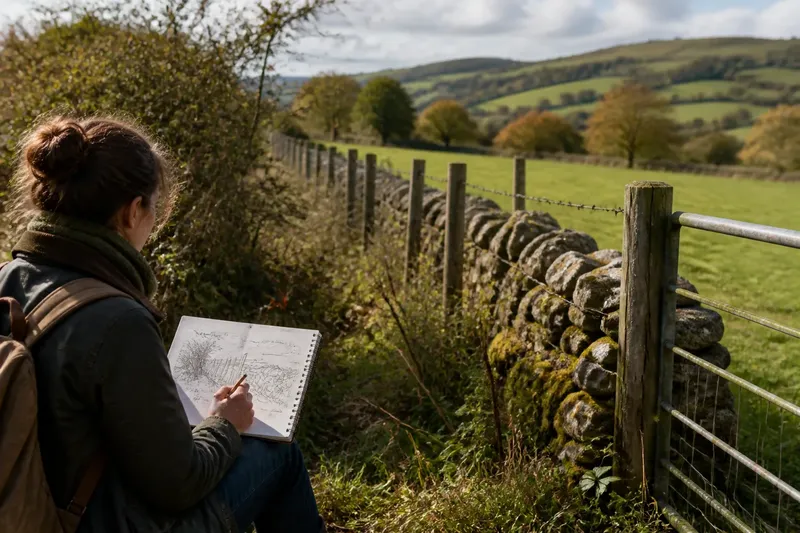
You stop beside a field gate to sketch the boundary, but the line refuses to sit still: thorny growth hides the ground, a stone wall changes height, and wire glints between posts. A hedge, wall or fence can all mark a field edge, yet each makes different details easy to see—and different ones easy to miss.
Close observation gets easier when you treat the boundary as a set of visible features rather than trying to name its whole history at a glance. The practical question is not only “What is it?” but “What can I see clearly here, and what might be concealed?”
Why does a field edge seem to change as you look?
Edges are not always single objects. A hedge may grow over an old bank; a wall may have wire added along its top; a fence may stand beside a ditch. Vegetation, repairs and seasonal growth can make one feature look like another, or hide the feature that gives the clearest clue.
Begin with the parts you can identify without guessing: living stems, stones, posts, rails, mesh, a ditch, or a raised strip of earth. Note where one material begins and another ends. A simple sketch with labels such as “thorn growth,” “upright stones” and “wire” is often more useful than a confident name unsupported by what is visible.
It also helps to distinguish the boundary’s present appearance from its origin. A line may have been altered repeatedly, and its current form does not by itself reveal who made it or when. Think of it like a patched coat: the cloth and stitches are visible, but they do not tell you every occasion on which it was repaired.
What does a hedge make easy to notice?
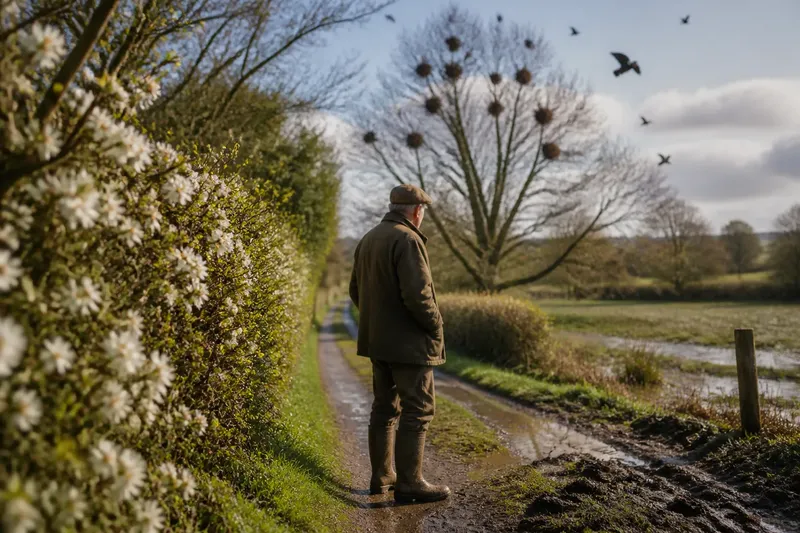
A hedge is a living line, so its stems, leaves, gaps and outline are the obvious features. Look for whether plants form a continuous mass or grow as separate shrubs; whether the edge is clipped or irregular; and whether branches bend, layer or rise above the main canopy. These observations describe structure without requiring you to identify every species.
Small openings matter. A gap may expose the hedge’s base, a ditch, a bank or a separate fence behind the plants. From one viewpoint, foliage can appear to reach the ground; from another, the lower stems may be clearly raised above bare soil. Record the view and the obstruction instead of treating one angle as the whole edge.
Season changes what is visible. Leaves can hide branching and ground-level structure, while leaf fall may reveal stems and the shapes of woody plants. Flowers, berries or foliage can help with identification, but a single visible plant does not necessarily characterize the whole hedge. If identification matters, note the feature and check it with an appropriate field guide rather than relying on a vague impression.
Dense growth can also make a hedge seem more solid than it is. Look for breaks, thin stretches and any separate posts or wire that continue behind it. A living screen may be the most noticeable part of the boundary without being the only boundary feature.
What can a stone wall tell you at a glance?
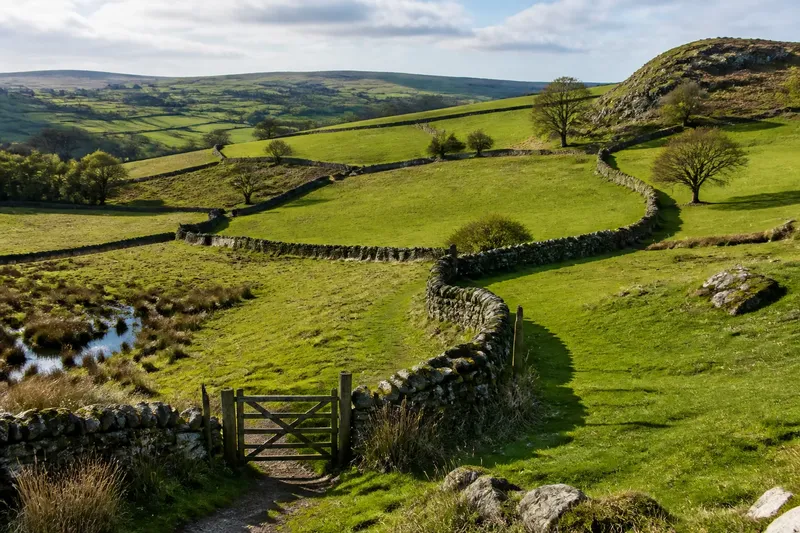
A stone wall offers a firm outline: a top, two faces where visible, and a base or adjoining ground. Notice how the stones are arranged, whether they appear roughly similar or varied in shape, and whether the upper edge is even, stepped or broken. A change in stone size or arrangement can mark a repair or alteration, though it does not establish when or why it happened.
Walls make gaps and changes of profile easy to spot. A missing stone, a sagging section or a place where the wall narrows is often more legible than a comparable opening in dense growth. Look along the length as well as at one section; a wall that appears uniform close up may have a bend, a low stretch or a change in material farther on.
At the base, grass, brambles or fallen stones may obscure the line where masonry meets soil. At the top, a fence or hedge may sit directly on the wall. Describe each layer separately: “stone wall with wire above” is more precise than choosing either “wall” or “fence” as the sole label.
Do not infer construction technique or age from a quick look alone. The stones you can see may have been moved, reset or supplemented. For a close observation, record the visible arrangement and any clear damage; leave hidden foundations and past use as open questions.
Why can a fence be harder to read than it looks?
Many fences are made of repeated parts—posts, rails, wire or mesh—so their pattern is easy to follow. Count neither posts nor spans as a measure of anything; instead, note the materials and how they connect. Is the line made of timber rails, wire strands, mesh panels or a combination? Does it follow the ground, or leave a visible gap beneath it?
Because a fence is often visually open, the land beyond it remains easy to see. That can make the boundary seem less substantial than a hedge or wall, even when its line is clearly defined. Conversely, tangled vegetation can conceal its posts and make a fence look like a hedge until you notice a repeated upright or a taut strand.
Check whether the fence stands alone or is attached to another feature. Posts fixed into a wall, wire running behind shrubs, or a gate set between different materials can reveal that the field edge is a combination. Weathering, rust, leaning posts and broken strands are observable conditions, but they do not explain the cause without more evidence.
Keep a respectful distance and do not handle wire, climb a wall or push through vegetation to improve a view. A boundary may be on private land or contain hazards that are not obvious. Observe from a public path or another place where you are entitled to stand.
What should you try when the boundary is confusing?
When the edge is hard to classify, use a short sequence that separates observation from interpretation:
- Choose a safe viewpoint. Stand on a public path or other permitted ground, and look along the boundary rather than only at it.
- Name the visible materials. Write down living stems, stone, timber, wire, mesh, soil or water without deciding yet which material “counts” most.
- Look for repeated forms. Posts, rails, stone courses and clumps of shrubs create different patterns; record the pattern you can actually follow.
- Check what is concealed. Note whether leaves, tall grass, a bank or a bend hides the base, top or continuation of the line.
- Separate joined features. Describe a wall with a fence above it, or a hedge with wire behind it, as a combination.
- Compare another viewpoint. If a permitted path offers one, see whether the same feature remains visible from the side or farther along.
- Leave uncertain claims open. Mark “possible ditch” or “unclear lower edge” rather than turning an incomplete view into a firm identification.
Say you are sketching a boundary from a public lane and can see thorny growth, but not its base. A repeated line of wooden posts appears through a gap, while a shallow hollow runs beside the plants. You could record “hedge with visible fence posts; possible ditch, base obscured” and sketch the hollow. That note captures what is observable and what remains uncertain without forcing the whole edge into one category.
Which features help you compare edges fairly?
Use the same kinds of observations for each boundary, even though the materials differ. A compact field note can cover:
- Continuity: Does the visible feature run without interruption, or are there openings and breaks?
- Height and profile: Is the top level, uneven, clipped, stepped or difficult to see?
- Materials: Which living and nonliving materials are present, and where do they meet?
- Ground contact: Can you see the base, or do grass, a bank, a ditch or debris conceal it?
- Added features: Is there wire, mesh, a gate or another boundary built into or beside the main one?
- Condition: Are there obvious gaps, fallen stones, broken rails, leaning posts or thin growth?
- Viewpoint: What can you see from where you are, and which part is hidden?
This shared vocabulary makes a hedge, wall and fence comparable without pretending they are built or maintained in the same way. “Open at the base, dense above” can describe a hedge; “uneven top, intact face” can describe a wall; “mesh visible, lower edge obscured” can describe a fence. Each phrase stays close to the evidence.
What questions help identify a field edge?
Can a field boundary contain a hedge and a fence?
Yes. A fence may run behind or through a hedge, and vegetation can partly conceal its posts or wire. Record both features when each is visible instead of treating the boundary as a single material.
Does a stone wall always stand by itself?
No. Wire, mesh or vegetation may be added above or beside masonry, and the wall’s base may be obscured by growth or soil. Describe the visible layers and avoid assuming that the exposed stones show the entire structure.
How can I tell a hedge from scrub?
Look for a continuing line, a managed outline, or repeated gaps and stems, but treat these as clues rather than a decisive test. If the edge is irregular or partly concealed, note its appearance without forcing a label.
What should I write when I cannot identify the boundary?
List the materials and features you can see, then state what is hidden or uncertain. “Mixed woody growth with posts behind it; lower edge not visible” gives a reader more to work with than a guess presented as fact.
How do you choose useful features to observe?
Start with the feature that answers the question you have. If you want to compare visibility, note what can be seen through or over the edge. If you want to describe construction, focus on the materials and their arrangement. If the boundary seems mixed, record where each component begins and what conceals it.
For a field edge, the most useful observation is often modest: a hedge hides its base, a wall shows a broken top, or a fence continues behind a patch of bramble. The phrase “hedge, wall or fence field edge” names three familiar forms, but a close description can preserve the combinations and uncertainties that a single label would flatten.
On your next walk, choose one visible feature and write down exactly what makes it easy—or difficult—to see. A good field note does not need to solve the boundary’s history; it needs to leave the next observer with a clearer view of what is actually there.